-Photoroom(1.png)
5 Reasons the Maruti Suzuki e-Vitara is Outselling the Hyundai Creta EV
- Jun 10
- 3 min read
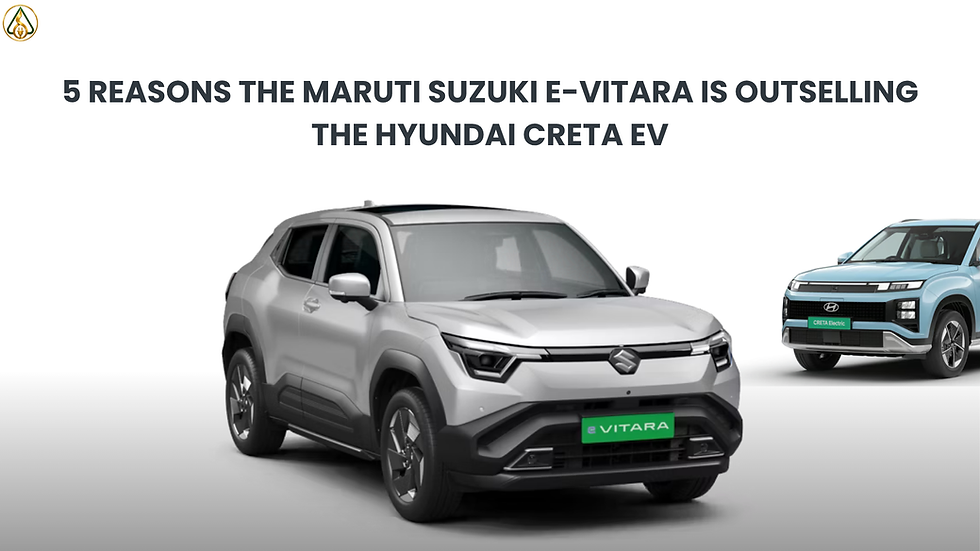
The Indian electric SUV market has heated up in 2026, and a surprising leader is emerging. According to recent May 2026 sales data, the Maruti Suzuki e Vitara is reportedly outselling the Hyundai Creta Electric by a significant margin—roughly 3.5 times—moving 1,591 units compared to its Korean rival.
While both are competent mid-size electric SUVs, buyers are increasingly voting with their wallets for Maruti’s first-ever EV. Here are five valid reasons why the e Vitara is pulling ahead.
1. Aggressive Pricing and a Game-Changing BaaS Model
The most obvious advantage is price. The Maruti e Vitara starts at ₹15.99 lakh (ex-showroom), while the Hyundai Creta Electric kicks off at ₹18.02 lakh—a gap of over ₹2 lakh at the entry point. That difference only widens as you climb the variant ladder; the top-end Creta Electric costs ₹24.70 lakh, whereas the fully loaded e Vitara Alpha Dual Tone tops out at ₹20.01 lakh.
But Maruti didn’t stop at sticker prices. It introduced a Battery-as-a-Service (BaaS) scheme that effectively drops the entry cost to ₹10.99 lakh for the base Delta variant. Under this plan, buyers pay a monthly battery subscription fee based on usage (around ₹3.99–₹4.39 per km), removing the biggest psychological barrier to EV adoption: the expensive battery pack. Hyundai currently offers no comparable program, making the e Vitara accessible to a much wider audience.
2. Safer, More Durable LFP Battery Chemistry
The user specifically mentioned this, and it’s a genuinely big deal. The Maruti e Vitara uses Lithium Iron Phosphate (LFP) battery cells sourced from BYD, available in 49 kWh and 61 kWh packs.
LFP batteries are renowned for their thermal stability, longer cycle life, and cobalt-free chemistry, which means reduced risk of thermal runaway and none of the ethical sourcing concerns tied to cobalt mining.
In contrast, the Hyundai Creta Electric relies on NMC (Nickel-Manganese-Cobalt) cells. While NMC offers higher energy density, it is more sensitive to degradation if regularly charged to 100% or drained deeply, and it carries a higher fire risk under extreme puncture or heat conditions. For Indian buyers who prioritize safety and long-term battery health—especially given our hot climate and unpredictable road conditions—LFP is increasingly seen as the more sensible choice.
3. Born-EV Platform with Better Space and Range Efficiency
The e Vitara rides on a dedicated skateboard EV platform, purpose-built from the ground up as an electric vehicle. This gives it a 2,700 mm wheelbase, a full 90 mm longer than the Creta Electric’s 2,610 mm, translating into noticeably better rear-seat legroom and a more planted stance.
Despite the Creta being slightly longer overall, the e Vitara’s dedicated architecture allows for more efficient packaging. It also delivers a claimed range of up to 543 km (61 kWh variant), edging out the Creta Electric’s maximum of 510 km. Even the base 49 kWh e Vitara promises 440 km, while the base 42 kWh Creta offers around 420 km. More range for less money is a hard proposition to beat.
4. Faster DC Charging and Larger Battery Options
When it comes to road-trip practicality, charging speed matters. The e Vitara can juice up from 10–80% in just 45 minutes via DC fast charging. The Creta Electric, meanwhile, takes 58 minutes for the same SOC window. That 13-minute difference adds up on highway stops.
Additionally, Maruti offers a larger 61 kWh battery pack on its top variants, whereas Hyundai caps out at 51.4 kWh. The e Vitara also supports up to 150 kW DC fast charging, while the Creta’s peak rate is lower, making the Maruti more future-proof as India’s charging infrastructure evolves.
5. Maruti’s Unmatched Service Network and Safety Credentials
Maruti Suzuki’s biggest moat has always been its trust and reach. With over 4,564 sales and service touchpoints across 2,304 cities, the brand offers a peace-of-mind ecosystem that Hyundai simply cannot match in scale. For first-time EV buyers nervous about after-sales support, knowing that a Maruti workshop is likely just around the corner is a massive comfort.
On the safety front, the e Vitara comes with 7 airbags and has secured a 5-star Bharat NCAP rating for both adult and child occupancy. The Creta Electric offers 6 airbags and is yet to be crash-tested by Bharat NCAP. Add in Maruti’s complimentary 7.4 kW AC home charger and free dealership charging for early buyers, and the ownership package becomes even more compelling.
Bottom Line
The Hyundai Creta Electric is a polished product with a premium interior, larger boot (433L vs 310L), and features like a panoramic sunroof. But for the mass-market buyer stepping into their first EV, the Maruti e Vitara simply offers a more convincing value proposition: it’s cheaper, uses safer LFP batteries, charges faster, offers more range, and comes backed by India’s largest service network. Until Hyundai narrows the price gap or matches the battery and charging specs, the sales charts are likely to keep favoring the e Vitara.


