-Photoroom(1.png)
Bajaj Chetak 3001(EV) vs. TVS Jupiter 125(ICE): A 5-Year Ownership Cost Analysis
- Apr 24
- 2 min read
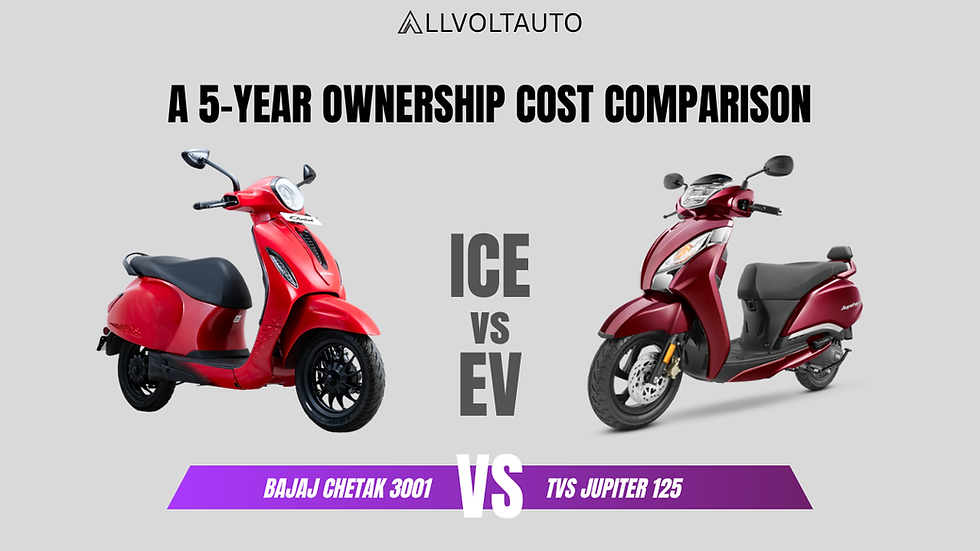
When deciding between a traditional internal combustion engine (ICE) scooter and an electric vehicle (EV), looking past the initial price tag is essential. The following professional breakdown provides a comprehensive 5-year Total Cost of Ownership (TCO) comparison between the TVS Jupiter 125 and the Bajaj Chetak 3001 EV.
These calculations are based on an estimated 10,000 km running. Please note that these figures are approximate, as electricity charges and fuel prices differ in each state, impacting overall ownership expenditure.
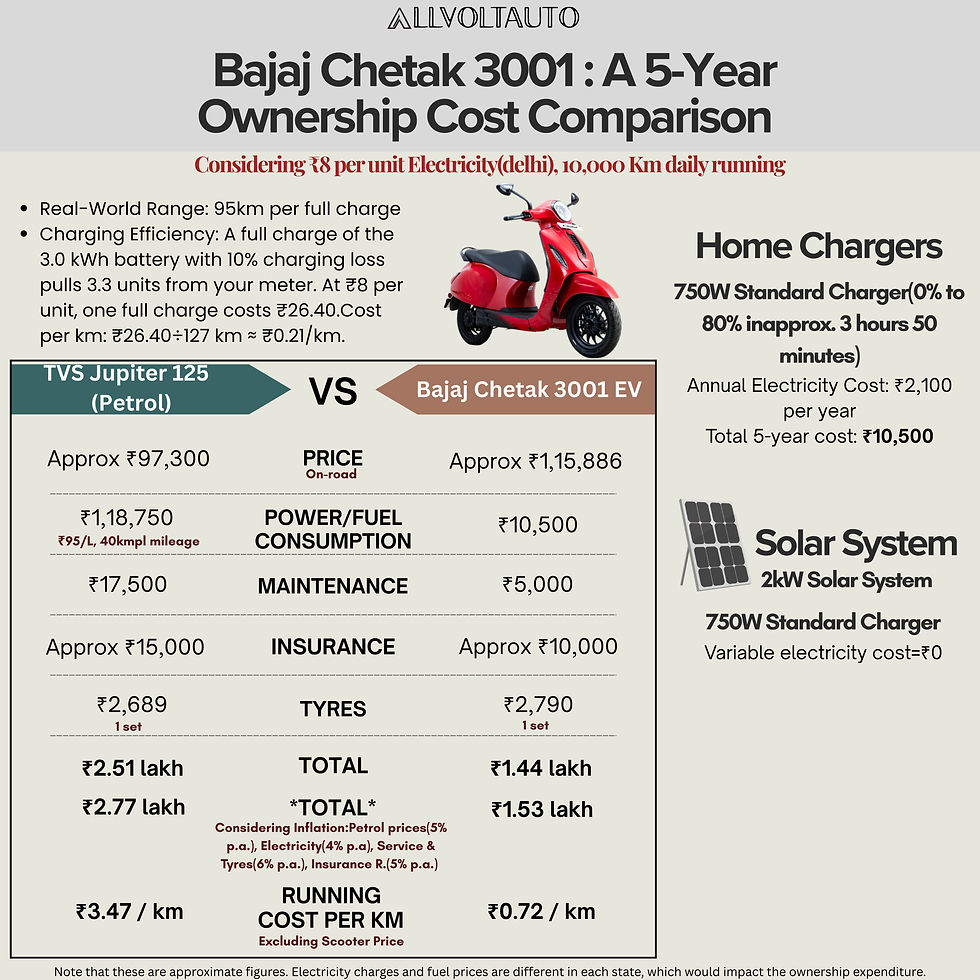
1. 5-Year Base Cost Breakdown
The table below outlines the upfront and ongoing expenses over a 5-year period before adjusting for inflation.
Expense Category | TVS Jupiter 125 (Petrol) | Bajaj Chetak 3001 EV |
On-Road Price | Approx ₹97,300 | Approx ₹1,15,886 |
Power / Fuel Consumption | ₹1,18,750 (at ₹95/L, 40kmpl) | ₹10,500 |
Maintenance | ₹17,500 | ₹5,000 |
Insurance | Approx ₹15,000 | Approx ₹10,000 |
Tyres (1 Set) | ₹2,689 | ₹2,790 |
Total Base Cost | ₹2.51 lakh | ₹1.44 lakh |
2. Understanding the EV Running Cost Calculations
The significant savings of the Bajaj Chetak 3001 come from its highly efficient energy consumption. Here is exactly how the EV running costs are calculated, assuming a Delhi electricity rate of ₹18 per unit (though the specific cost calculation below utilizes an ₹8 per unit baseline for charging ).
EV Efficiency & Charging Metric | Data & Calculation |
Real-World Range | 95km per full charge |
Charging Efficiency | A full charge of the 3.0 kWh battery with 10% charging loss pulls 3.3 units from the meter. |
Cost Per Charge | At ₹8 per unit, one full charge costs ₹26.40. |
Cost Per Kilometer | ₹26.40 ÷ 127 km ≈ ₹0.21/km. |
Annual Electricity Cost | ₹2,100 per year. |
Total 5-Year Power Cost | ₹10,500. |
3. Total Cost of Ownership (Considering Inflation)
To project real-world financial realities over 5 years, we must apply inflation rates to ongoing costs. The model considers the following annual inflation rates: Petrol prices (5%), Electricity (4%), Service & Tyres (6%), and Insurance (5%).
TCO Metric | TVS Jupiter 125 (Petrol) | Bajaj Chetak 3001 EV |
Total (Considering Inflation) | ₹2.77 lakh | ₹1.53 lakh |
Running Cost Per Km* | ₹3.47/km | ₹0.72/km |
*Note: Running cost per km excludes the initial scooter purchase price.
4. Charging Infrastructure & Further Optimization
Charging the EV is convenient with a standard home setup. A 750W Standard Charger can take the scooter from 0% to 80% in approximately 3 hours and 50 minutes.
For riders seeking to eliminate their daily running expenses entirely, integrating a 2kW Solar System with the 750W Standard Charger can bring the variable electricity cost down to ₹0.
While the TVS Jupiter 125 has a lower entry price, the Bajaj Chetak 3001 ultimately proves to be the much more economical choice over a 5-year timeline, saving owners over ₹1.24 lakh when factoring in inflation.
Conclusion
While the TVS Jupiter 125 is cheaper to drive off the lot, the Bajaj Chetak 3001 is substantially more economical over a 5-year timeline. Thanks to minimal electricity costs and lower maintenance requirements, the EV option ultimately saves over ₹1.24 lakh in inflation-adjusted total ownership costs.


