-Photoroom(1.png)
Bajaj Chetak 3001 vs. Suzuki Access 125: A 5-Year Ownership Cost Analysis
- Apr 19
- 2 min read
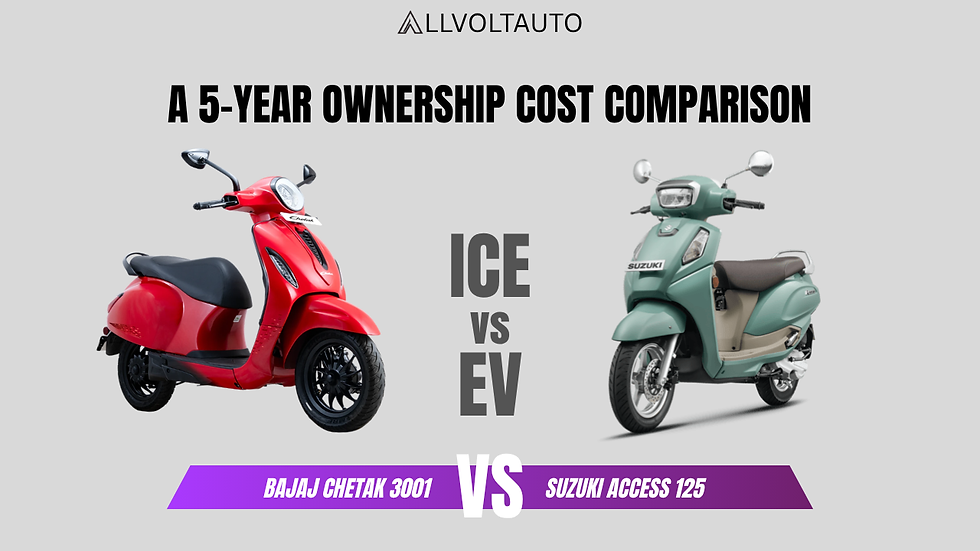
Choosing between a classic petrol scooter and a modern electric one often comes down to the long-term impact on your wallet. This analysis breaks down the 5-year running costs of the Bajaj Chetak 3001 compared to the Suzuki Access 125, specifically for a rider in Delhi covering 10,000 km annually.

Comparison Overview: On-Road and Maintenance
While the initial price of the Chetak is higher, the operational savings begin almost immediately.
Feature | Suzuki Access 125 (Petrol) | Bajaj Chetak 3001 (EV) |
On-Road Price | Approx. ₹97,300 | Approx. ₹1,15,886 |
Fuel/Power Cost | ₹1,18,750 (at ₹95/L) | ₹10,500 |
Maintenance | ₹17,500 | ₹5,000 |
Insurance | Approx. ₹15,000 | Approx. ₹10,000 |
Tyres (1 Set) | ₹2,689 | ₹2,790 |
Total (5 Years) | ₹2.51 Lakh | ₹1.44 Lakh |
Detailed Running Costs & Inflation
To get a realistic picture, we must account for rising costs over half a decade. We applied annual inflation rates of 5% for petrol, 4% for electricity, 6% for service and tyres, and 5% for insurance.
Suzuki Access 125 Total: ₹2.77 Lakh (Cost per km: ₹3.47).
Bajaj Chetak 3001 Total: ₹1.53 Lakh (Cost per km: ₹0.72).
Note: These calculations exclude the initial scooter purchase price to focus strictly on running expenses.
Charging Dynamics: The Heart of EV Ownership
The Chetak 3001 features a 3.0 kWh battery with a real-world range of 95 km per full charge.
1. Home Charging (Standard)
Using a 750W Standard Charger, a charge from 0% to 80% takes approximately 3 hours and 50 minutes.
Efficiency: Including a 10% charging loss, a full charge pulls 3.3 units from your meter.
Cost in Delhi: At ₹8 per unit, one full charge costs ₹26.40.
Annual Cost: Approx. ₹2,100 per year.
5-Year Total: ₹10,500.
2. Solar Charging
For those with a 2kW Solar System, the variable electricity cost can be reduced significantly, effectively bringing the cost of power down to ₹0 in ideal conditions.
Explaining the Calculations
To understand how we reached a running cost of ₹0.72/km for the Chetak vs. ₹3.47/km for the Access, consider these formulas:
EV Cost per KM: A full charge costs ₹26.40 and covers roughly 127 km (efficiency adjusted), resulting in approximately ₹0.21/km for power alone. When insurance, maintenance, and inflation are added over 5 years, the total average becomes ₹0.72/km.
Petrol Cost per KM: Based on a mileage of 40 kmpl and petrol at ₹95/L, the base fuel cost is ₹2.37/km. Adding service and inflation brings the total average to ₹3.47/km.
Final Verdict
The Bajaj Chetak 3001 offers a massive ₹1.24 Lakh saving over five years compared to the Suzuki Access 125. While regional differences in electricity and fuel prices will impact these figures, the EV remains the clear financial winner for the high-mileage urban commuter.


