-Photoroom(1.png)
Comparing Ather 450X Charging Options: Standard Charger, Duo, and Solar Solutions
- Mar 14
- 3 min read
Updated: Mar 15
This analysis breaks down the available charging methods—solar, home standard, home duo, and hybrid public-grid—and compares them against an equivalent internal combustion engine (ICE) scooter.
In the rapidly evolving landscape of electric mobility, the decision to switch from internal combustion to electric is often driven by the promise of lower running costs. However, for the discerning owner, the question isn't just "Is it cheaper than petrol?" but rather, "What is the most efficient way to charge my vehicle?"
Using data from a recent cost analysis of the Ather 450X (3.7kWh battery) in a Delhi NCR scenario, we break down the real-world expenditure associated with different charging methodologies. Whether you are a daily commuter or a weekend rider, understanding the nuances between a standard charger, a fast charger, and public grid dependency can lead to significant long-term savings.
(Assuming an electricity tariff of ₹8 per unit and a daily running of 50 km.)
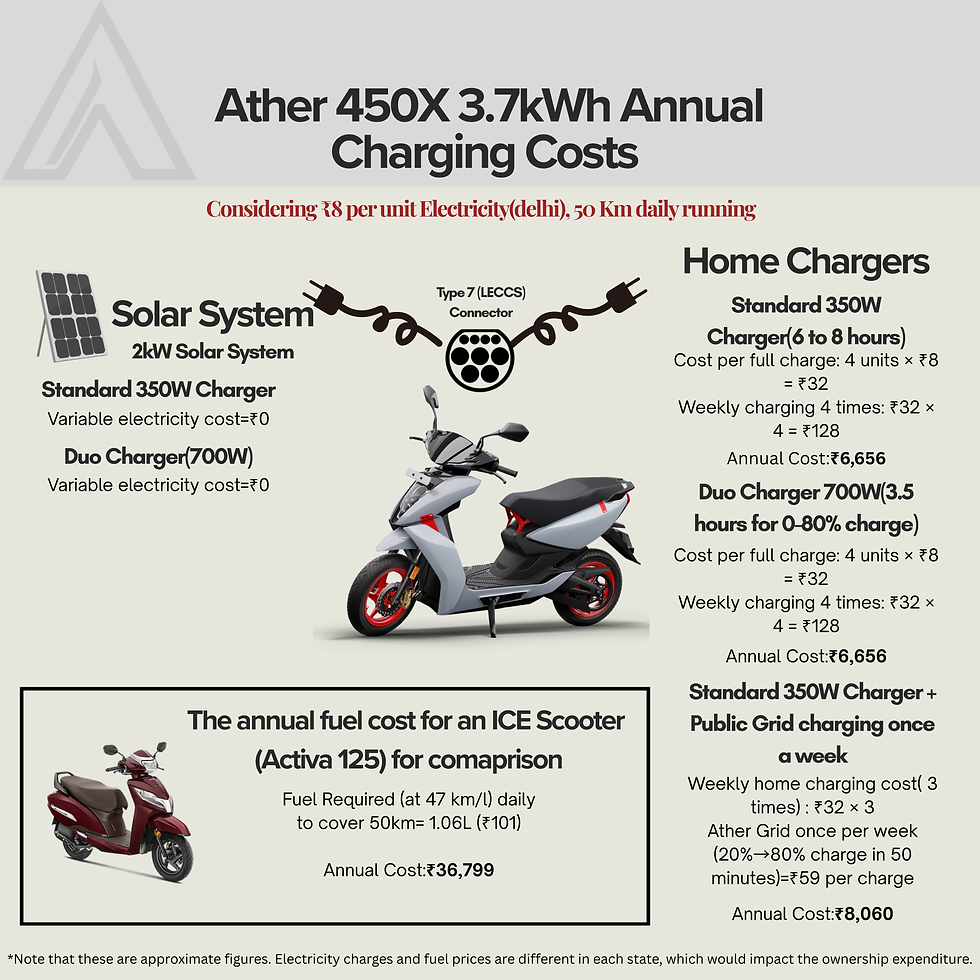
1. The Baseline: Standard Home Charging (350W)
The "Set It and Forget It" Approach
The Ather 450X comes standard with a 350W portable charger. This is the most basic form of replenishing your battery, typically taking between 6 to 8 hours for a full charge.
Energy Consumption: 4 units per full charge.
Cost per Full Charge: 4 units × ₹8 = ₹32.
Weekly Cost (4 charges): ₹32 × 4 = ₹128.
Annual Outlay: ₹6,656.
Analysis: This is the financial baseline. It represents the maximum convenience at home, utilizing off-peak hours overnight. The cost is predictable and immune to fuel price volatility.
2. The Speed Option: Duo Charger (700W)
Faster, But Not Pricier
For those who need quicker turnaround times, the Ather Duo Charger doubles the charging speed, taking the battery from 0 to 80% in approximately 3.5 hours.
Cost per Full Charge: 4 units × ₹8 = ₹32.
Weekly Cost (4 charges): ₹32 × 4 = ₹128.
Annual Outlay: ₹6,656.
Analysis: This is a critical revelation for potential buyers. Speed does not incur a cost penalty. Whether you trickle charge slowly or use the faster Duo charger, the electricity tariff remains the same. The only variable is the initial hardware investment for the charger itself, not the running cost.
3. The Hybrid Scenario: Home + Public Ather Grid
The Convenience Surcharge
While home charging is the most economical, the reality of urban life sometimes necessitates a top-up at a public Ather Grid fast charger. This scenario assumes a mix of three home charges and one public grid charge per week (charging from 20% to 80% in 50 minutes).
Weekly Home Charging (3 times): ₹32 × 3 = ₹96.
Ather Grid (Once a week): ₹59 per charge.
Total Weekly Cost: ₹96 + ₹59 = ₹155.
Annual Outlay: ₹8,060.
Analysis: Relying on public infrastructure once a week increases your annual expenditure by roughly 21% compared to pure home charging (₹1,404 more per year). This is the "convenience tax" for using fast DC charging, though it remains drastically cheaper than petrol.
4. The Ultimate Offset: Solar Integration
The Zero-Variable-Cost Ceiling
The PDF highlights a futuristic scenario involving a 2kW Solar System. When your home charger is connected to a solar setup, the variable cost of electricity effectively drops to ₹0.
Standard or Duo Charger Cost: ₹0.
Annual Outlay: ₹0 (Variable).
Analysis: While this requires a significant upfront capital investment in solar panels and infrastructure, it represents the pinnacle of operational expenditure reduction. For the environmentally conscious or those looking to hedge against rising energy costs, this transforms the vehicle from a low-cost machine into a negative-cost asset.
The ICE Age Comparison: A Reality Check
To contextualize these figures, the analysis compares the annual running cost of the Ather against a petrol-powered Honda Activa 125.
Fuel Efficiency: 47 km/l.
Daily Fuel Need (50 km): 1.06 Liters.
Annual Fuel Cost: ₹36,799.
Conclusion: Even in the most expensive charging scenario (Hybrid Home + Grid), the Ather 450X costs ₹8,060 annually to run. Compared to the Activa’s ₹36,799, the electric scooter saves the owner ₹28,739 per year.


