-Photoroom(1.png)
Honda Activa 6G vs TVS iQube 2.2: 5-Year Total Cost of Ownership Comparison
- Feb 25
- 3 min read
We compare the top selling petrol scooter against the top selling EV scooter to see which one makes more sense in long term.

A five-year Total Cost of Ownership analysis provides a clearer picture of the real financial commitment involved.Based on the estimates for 50,000 km of usage over five years, this article compares the Honda Activa 6G (petrol) and the TVS iQube 2.2 (electric) across key cost components including purchase price, fuel/energy consumption, maintenance, insurance, and total expenditure.
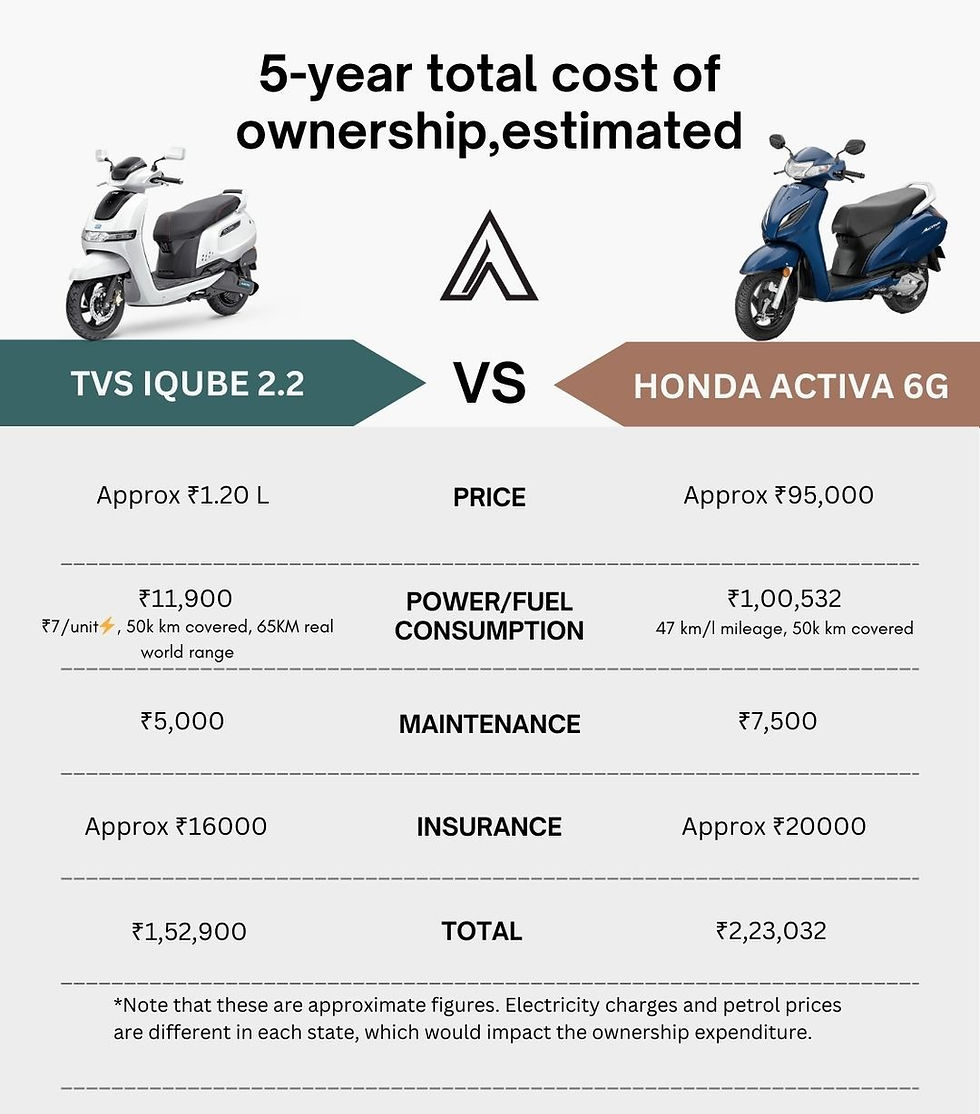
The Total Cost of Ownership (TCO) comparison between the TVS iQube 2.2 (electric scooter) and the Honda Activa 6G (petrol scooter) over 5 years is a key consideration for buyers in India, especially amid rising fuel costs and growing interest in electric mobility. The provided estimate highlights significant potential savings with an electric option, primarily due to lower running costs.
This analysis assumes 50,000 km total distance covered over 5 years (averaging 10,000 km annually, a typical urban commuting figure). Note that these are approximate figures, and actual costs vary by location (e.g., electricity and petrol prices in Uttar Pradesh, where Agra is located), riding style, maintenance habits, and any subsidies or incentives.
Key Assumptions for the Provided Comparison
Annual distance: 10,000 km (total 50,000 km over 5 years).
TVS iQube 2.2:
Real-world range: ~65 km per charge (conservative estimate; recent data suggests closer to 75-90 km depending on mode and conditions).
Electricity cost: ₹7 per unit.
Honda Activa 6G:
Real-world mileage: 47 km/l (aligns with user reports of 45-55 kmpl in mixed conditions).
Other costs (maintenance and insurance) are estimates and may fluctuate.
Detailed Explanation of Major Components
Purchase Price: The TVS iQube carries a premium (~₹25,000 higher in the estimate) due to its battery pack and electric drivetrain. However, government incentives (FAME subsidies, state EV benefits) and falling battery costs have narrowed the gap in recent years.
Fuel/Power Costs (Biggest Savings Driver):
iQube: At ₹7/unit and 65 km real-world range, energy consumption is low. For 50,000 km: Energy needed ≈ 50,000 km / 65 km per charge ≈ 769 full charges. Assuming 2.2 kWh battery (with charging efficiency), total units ≈ 1,700 units (rough calc). At ₹7/unit: ₹11,900 . In Uttar Pradesh (Agra area), domestic rates are slab-based (~₹5.50-7/unit for typical home charging), so actual could be similar or lower.
Activa: At 47 km/l and current Agra petrol ₹94-95/liter: Fuel needed = 50,000 / 47 ≈ 1,064 liters. Cost ≈ 1,064 × ₹94.5 ≈ ₹1,00,500. Petrol prices fluctuate, but they remain significantly higher than electricity.
Maintenance: Electric scooters like the iQube require mainly brake checks, tire rotations, and software updates;minimal compared to petrol scooters' oil changes, spark plugs, belts, and carburetor cleaning. The estimate reflects this advantage.
Insurance: Slightly lower for electric in the estimate, possibly due to no-fuel risk and newer tech. Comprehensive coverage for both would add similar third-party costs, but quotes vary.
Overall Verdict
Over 5 years and 50,000 km, the TVS iQube 2.2 emerges as the more economical choice with a total estimated cost of ₹1.53 lakh versus ₹2.23 lakh for the Honda Activa 6G- a savings of approximately ₹70,000 (around 31%). The breakeven point (where electric savings offset the higher upfront cost) occurs relatively quickly, often within 2-3 years for moderate users.
Beyond numbers, consider:
Environmental impact: Zero tailpipe emissions with iQube.
Riding experience: Silent, instant torque for iQube; proven reliability and widespread service for Activa.
Practicality: Home charging convenience vs. quick petrol refills; range anxiety for longer trips with electric (though sufficient for most urban use).
Note:State-wise variations in electricity (around ₹6-8/unit in UP) and petrol prices can shift totals, but the trend favors electric for cost-conscious urban riders. For personalized figures, check current on-road prices and local fuel/electricity rates. If your usage differs (e.g., higher km), the savings amplify further with the iQube.


