-Photoroom(1.png)
Solar-Powered Mobility: A Guide to Charging Electric Vehicles in Europe
- Mar 21
- 3 min read
As Europe accelerates its transition to electric mobility under the EU Green Deal and Alternative Fuels Infrastructure Regulation (AFIR), pairing solar photovoltaic (PV) systems with electric vehicles (EVs) offers a sustainable, cost-effective way to charge.
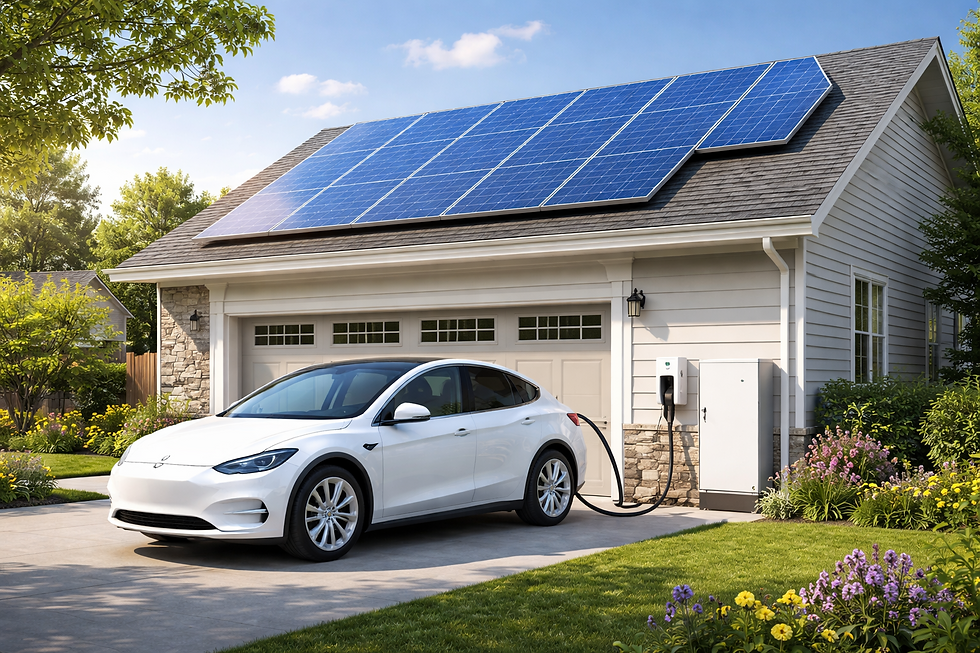
As Europe accelerates its transition toward sustainable transportation, the synergy between solar energy and electric vehicles (EVs) has become a focal point for homeowners and businesses alike. Integrating a solar photovoltaic (PV) system with an EV charging setup not only reduces carbon footprints but also offers significant long-term financial savings. This article explores the types and capacities of solar systems required to charge various electric vehicles, from nimble 2-wheelers to robust 4-wheelers, within the European context.
Understanding the European Solar Landscape
The capacity of a solar system required for EV charging is heavily influenced by geographic location. Europe’s solar potential varies significantly from North to South:
Region | Average Annual Yield (kWh/kWp) | Daily Average Yield (kWh/kWp) |
Northern Europe (e.g., Germany, UK, Scandinavia) | 900 – 1,100 | 2.5 – 3.0 |
Central Europe (e.g., France, Austria, Poland) | 1,100 – 1,300 | 3.0 – 3.6 |
Southern Europe (e.g., Spain, Italy, Greece) | 1,500 – 1,800 | 4.1 – 4.9 |
Note: These figures represent the energy produced per kilowatt-peak (kWp) of installed solar capacity. A typical residential solar panel in 2026 produces approximately 400–450 Watts.
EV Energy Requirements: 2-Wheelers vs. 4-Wheelers
To determine the solar capacity needed, we must first understand the energy consumption of the vehicles.
1. Electric 2-Wheelers (E-Bikes and E-Scooters)
Electric 2-wheelers are highly efficient and require minimal energy compared to cars.
Battery Capacity: Typically ranges from 0.5 kWh to 4 kWh.
Energy Consumption: Approximately 2–5 kWh per 100 km.
Charging Needs: Most can be charged via a standard European domestic socket (Schuko) at 2.3 kW.
2. Electric 4-Wheelers (Passenger Cars)
Electric cars vary widely in battery size and efficiency.
Compact/City Cars (e.g., Fiat 500e, Dacia Spring): 25 – 45 kWh battery.
Standard/Long Range (e.g., Tesla Model 3, VW ID.4): 60 – 85 kWh battery.
Energy Consumption: Average of 15–20 kWh per 100 km.
Solar System Types for EV Charging
Choosing the right system architecture is crucial for maximizing self-consumption.
On-Grid Systems (Grid-Tied)
The most common setup in Europe. It feeds excess solar energy into the public grid.
Pros: Lower initial cost; can use "Net Metering" (where available) to offset night charging.
Cons: Does not work during power outages; requires the grid to "buffer" energy if charging at night.
Hybrid Systems (Solar + Battery Storage)
Includes a home battery (e.g., 5–15 kWh) to store solar energy for later use.
Pros: Ideal for EV owners who work during the day and charge at night.
Cons: Higher upfront investment due to battery costs.
Off-Grid Systems
Independent of the utility grid.
Pros: Total energy independence.
Cons: Extremely expensive for 4-wheeler charging due to the massive battery and PV array required to ensure reliability during winter months.
Calculating Required Solar Capacity
The "required capacity" depends on whether you aim for Full Charging (covering the entire battery from empty) or Partial Charging (covering daily commuting needs).
Scenario A: Daily Commuting (Partial Charging)
The average European driver covers approximately 35 km per day.
4-Wheeler Need: ~7 kWh/day (including 15% charging losses).
2-Wheeler Need: ~1.5 kWh/day.
Vehicle Type | Solar Capacity Needed (North Europe) | Solar Capacity Needed (South Europe) |
2-Wheeler | 0.6 – 1.0 kWp (2-3 panels) | 0.4 – 0.6 kWp (1-2 panels) |
4-Wheeler | 2.5 – 3.5 kWp (6-9 panels) | 1.5 – 2.0 kWp (4-5 panels) |
Scenario B: Full Weekly Charge (Full Charging)
If you wish to fully charge a 60 kWh battery once a week using only solar:
Total Energy Needed: ~70 kWh (including losses).
Required System: A 5–7 kWp system is generally recommended for most European households to ensure enough surplus energy for both the home and the vehicle.
Professional Recommendations for European Homeowners
1.Smart Charging (EVSE): Invest in a "Solar-Aware" wallbox. These devices communicate with your solar inverter to charge the car only when surplus solar energy is available, preventing you from drawing expensive power from the grid.
2.Phase Balancing: In many European countries (like Germany or the Netherlands), 3-phase charging (11 kW or 22 kW) is standard. Ensure your solar inverter is compatible with 3-phase loads to maximize efficiency.
3.Winter Considerations: In Northern Europe, solar production can drop by 80% in winter. A system sized for summer may only provide a "trickle charge" in December. Most users will rely on the grid during these months.
Conclusion
Charging an electric vehicle with solar energy in Europe is not only feasible but increasingly economical. For 2-wheelers, a small balcony solar setup or a couple of rooftop panels are often sufficient. For 4-wheelers, a standard residential system of 4–6 kWp paired with a hybrid battery offers the best balance of independence and cost-effectiveness. By aligning your charging habits with peak solar production, you can effectively drive on sunshine, contributing to a cleaner European transport ecosystem.


