-Photoroom(1.png)
A Detailed Look at Charging Costs for Tesla Model Y Owners in Europe: Home, Solar, and Public Options
- Mar 16
- 5 min read
With energy prices varying dramatically from Iceland to Norway, and a multitude of connection types available, understanding the true cost of powering a Model Y requires a detailed, Europe-centric analysis.
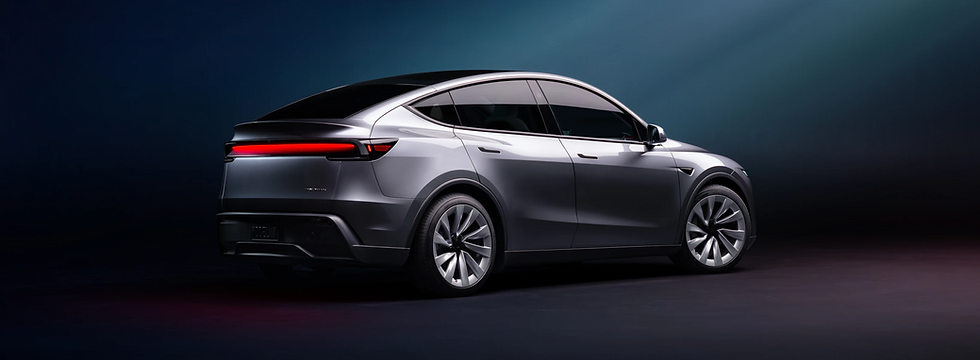
The Tesla Model Y remains one of Europe’s most popular electric vehicles, thanks to its spacious design, strong performance, and expanding Supercharger network. For owners across the EU, charging strategy is the single biggest factor in total cost of ownership. With household electricity prices stabilising around €0.287 per kWh (EU average, first half 2025 data, largely unchanged into 2026) and real-world energy consumption typically 15 kWh/100 km, understanding the options is essential. This analysis focuses exclusively on Europe-centric data and the 2025–2026 Model Y variants (onboard AC charger rated at 11 kW, DC fast charging up to 250 kW). We use realistic assumptions: 12,000 km annual driving (EU passenger-car average) and 15 kWh/100 km real-world consumption, yielding 1,800 kWh of annual energy demand. All costs are in euros and reflect 2026 market conditions, including dynamic pricing, installation averages, and solar economics.
Key Charging Capabilities of the European Model Y
AC home charging: 11 kW (3-phase) standard onboard charger — full charge in around 7 to 8 hours on a dedicated circuit.
DC fast charging: Up to 250 kW at V3/V4 Superchargers or compatible public stations (10–80 % in ~25–30 minutes).
Connector: Type 2 (Europe standard); Tesla Wall Connector or Mobile Connector recommended for home use.
Option 1: Home AC Charging (Recommended for Daily Use)
Home charging is the cheapest and most convenient for 90 %+ of European owners.
Tesla Mobile Connector (portable, up to 11 kW with appropriate adapter/circuit): Unit price ~€300. Minimal or no extra installation if using existing outlets. Annual electricity cost: 1,800 kWh × €0.28 = €504. Hardware amortised over 5 years: negligible (~€60/year). Total annual cost: ~€530–560.
Tesla Wall Connector (Gen 3, 11–22 kW capable): Unit ~€595–€600 (excl. VAT). Professional installation averages €800–€1,200 (cabling, circuit upgrade, permitting). Total upfront extra ~€1,000–€1,500 beyond the unit. Amortised over 10 years: €100–€150/year. Electricity remains €504. Total annual cost: ~€620–€670.
Advantages: Scheduled charging via Tesla app aligns with off-peak tariffs (often €0.18–€0.22/kWh in many countries), cutting costs another 20–30 %. Integration with Tesla ecosystem for preconditioning and energy tracking.
Drawbacks: Requires off-street parking and a suitable electrical supply (3-phase ideal).
Verdict: The baseline choice for most owners. Upgrading from Mobile to Wall Connector pays for itself in convenience and faster charging within 2–3 years.
Option 2: Public AC and Destination Charging
Workplace, shopping-centre, or hotel chargers (up to 22 kW AC).
Average price: €0.50–€0.65/kWh (2026 EU median).
Annual cost if used exclusively: 1,800 kWh × €0.57 ≈ €1,026.
Real-world use: Often free or discounted at workplaces/destinations, so hybrid home + public can keep costs under €700/year.
Advantages: No home installation needed; useful for apartment dwellers.
Drawbacks: Slower than DC, parking fees common, availability varies. Not viable as primary method.
Verdict: Supplementary only — never rely on public AC for daily commuting.
Option 3: DC Fast Charging (Superchargers & Public Networks)
For long trips or when home charging is unavailable.
Tesla Superchargers: Dynamic pricing €0.40–€0.70/kWh (off-peak often cheapest; membership ~€12/month can drop effective rate to €0.45–€0.55). 2026 EU average for non-subscription ~€0.55/kWh.
Other networks (Ionity, Electrify, Allego, etc.): €0.70–€0.85/kWh median for 150+ kW stations.
Annual cost if used exclusively: €990–€1,350 (impractical).
Realistic use: 10–20 % of annual energy for trips → adds €100–€200/year on top of home charging.
Advantages: 250 kW speeds, widespread network, open to non-Tesla EVs. Congestion fees apply only when busy.
Drawbacks: Most expensive per kWh; idle fees and peak pricing can inflate costs.
Verdict: Essential for road trips, but never a daily strategy — use for <15 % of charging to keep total ownership low.
Option 4: Solar-Powered Home Charging (Best Long-Term Investment)
Pairing solar PV with home charging transforms the Model Y into a near-zero running-cost vehicle.
System sizing for 1,800 kWh EV demand (plus typical household offset):
Europe average yield: ~900–1,200 kWh per kWp installed (Germany ~1,000; Spain/Italy higher).
Recommended: 4–5 kWp rooftop system (produces 3,600–6,000 kWh/year). Covers EV + partial home use.
2026 installed costs (EU average):
€1,400–€1,800 per kWp (modules now ~€0.10/Wp, full turnkey including inverter and labour).
4 kWp system: €5,600–€7,200 (zero VAT in many countries until 2027 in UK-equivalent schemes; national grants common).
Annualised cost (10-year payback typical): €560–€720 during payback period, then €0 thereafter.
With Tesla Powerwall 3 (13.5 kWh):
Unit + installation ~€7,500–€10,000.
Enables night-time EV charging from daytime solar, pushing self-consumption to 80–90 %.
Total system (4 kWp + Powerwall): €13,000–€17,000. Payback 8–12 years, but provides blackout resilience and tariff optimisation.
Net annual charging cost after payback: Near €0 (or small export-credit surplus). During payback: effectively €0.10–€0.20/kWh equivalent when factoring savings.
Advantages: Energy independence, protection against rising grid prices, EU Green Deal incentives (grants up to 50 % in some regions). EV charging during solar hours is essentially free.
Drawbacks: High upfront capital; payback varies by latitude and self-consumption rate. Apartment blocks often restricted.
Verdict: The smartest long-term choice for homeowners. A 4 kWp solar array plus Wall Connector typically pays for itself in 7–10 years and delivers decade-after-decade savings. Adding a Powerwall accelerates ROI for frequent night chargers.
Annual Cost Comparison Table (12,000 km, 1,800 kWh)
Charging Strategy | Upfront (excl. car) | Annual Electricity/Hardware | 5-Year Total (amortised) | 10-Year Total | Best For |
Mobile Connector (home) | €300 | €530 | €2,800 | €5,300 | Budget, renters |
Wall Connector (home grid) | €1,200–1,800 | €620–670 | €3,500–3,800 | €6,500 | Most owners |
Public AC only | €0 | €1,026 | €5,130 | €10,260 | Apartment (temporary) |
Supercharger/Public DC only | €0 | €990–1,350 | €5,500–7,000 | €11,000+ | Road-trip heavy |
Solar 4 kWp + Wall (no battery) | €6,000–8,000 | €0 (post-payback) | €4,000–5,000 | €4,000–6,000 | Long-term homeowners |
Solar + Powerwall + Wall | €14,000–18,000 | €0 (post-payback) | €7,000–9,000 | €7,000–9,000 | Maximum independence |
Final Evaluation and Recommendations
Short-term winner (0–5 years): Dedicated home Wall Connector on grid electricity (~€650/year). Simple, reliable, and far cheaper than any public-only strategy.
Long-term winner (5+ years): Solar PV + Wall Connector (ideally with Powerwall). After payback, annual charging cost drops to near zero while adding energy security — a compelling proposition with EU electricity prices still elevated.
Hybrid reality for most Europeans: 80 % home Wall Connector (night/off-peak), 15 % Supercharger for holidays, 5 % public AC. Add solar when roof space and budget allow; many owners report total 5-year savings of €3,000–€5,000 versus grid-only.
Country nuances: In high-price markets (Germany, Belgium ~€0.38/kWh) solar ROI is fastest. In sunnier southern Europe (Spain, Italy) smaller arrays suffice. Check local grants via your national energy agency — many cover 20–40 % of solar or charger costs.
Additional optimisations: Time-of-use tariffs, smart scheduling in the Tesla app, and V2G-ready tariffs (emerging 2026–2027) can shave another 15–25 % off home costs.
Charging a Tesla Model Y in Europe is no longer an expensive unknown — with home Level-2 charging and a modest solar investment, it becomes one of the lowest-cost forms of personal transport available. Owners who plan their charging ecosystem today will enjoy years of predictable, low-cost, and sustainable motoring.
Drive electric, charge smart, and let the sun do the rest.


