-Photoroom(1.png)
Titan Edge Mechanical 1810NP01: India's Thinnest Mechanical Watch — Is It Worth Over ₹2 Lakhs?
- Team ALLVOLTAUTO.com
- Jun 10
- 5 min read

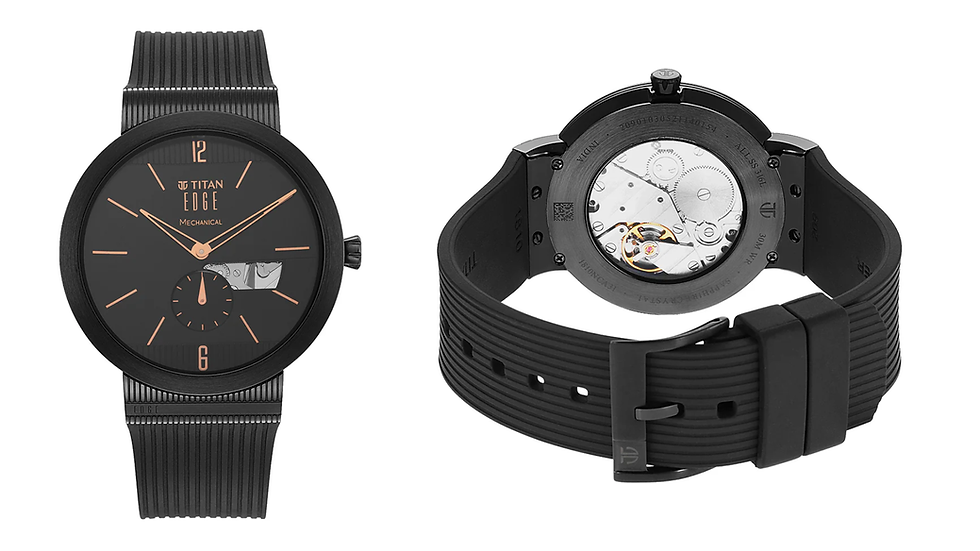
When you think of luxury mechanical watches, names like Rolex, Omega, and Jaeger-LeCoultre come to mind. Rarely does an Indian brand enter that conversation. Yet Titan — India's largest watchmaker and the fifth-largest in the world — decided to change that narrative with the Titan Edge Mechanical, specifically Edge Mechanical 1810NP01, priced at a staggering ₹2,19,500. This is not just a watch; it is a statement — a declaration that Indian horology can command a six-figure price tag and stand shoulder-to-shoulder with Swiss legends.
But the question remains: Is it actually worth over ₹2 lakhs?
Let us dive deep.
What Is the Titan Edge Mechanical 1810NP01?
The Titan Edge Mechanical 1810NP01 is the second-generation flagship of the Edge Mechanical line, launched in September 2022. It is an all-black, stainless-steel mechanical watch that represents the pinnacle of Titan's engineering ambition.
The watch features a partial open-heart dial at the centre, offering a glimpse into the ultra-thin movement — a design choice that adds visual drama without compromising the minimalist aesthetic. The all-black treatment, from the case to the dial to the FKM rubber strap, gives it a modern, stealth-luxury appeal. At 42 mm in diameter and under 6 mm thick, it wears incredibly slim and elegant on the wrist. The case is crafted from 316L stainless steel with a black PVD coating, a step up from the more common 304 grade used in cheaper watches. The crystal is sapphire on both the front and back, and the watch offers 30 metres of water resistance along with a 5-year movement warranty — exceptional for any brand, let alone an Indian one.
The Movement: The Real Hero
The Edge Calibre 903 is the soul of this watch. At just 2.2 mm thick, it is one of the slimmest mechanical movements in the world — thinner than the Bulgari BVL 138 (2.23 mm) and comparable to movements found in watches costing ten times as much. What makes this remarkable is that almost the entire movement is manufactured in India at Titan's facility in Coimbatore. After a decade of development, only a handful of components that could not be produced domestically were sourced from Switzerland. This is not a "Swiss movement in an Indian case" scenario — this is genuine, homegrown horology.
The movement comprises 106 parts and 18 jewels, delivers a 42-hour power reserve, and is entirely hand-wound. Sirish Chandrashekar, Marketing Head at Titan Watches, noted that the fundamental challenge was breaking the preconceived notion that Titan cannot make premium watches. The Edge Mechanical was designed to answer one question: "Why can't a Titan watch command a higher price point in the six-figure range?" The first generation sold out all 200 pieces by mid-August 2021 despite the pandemic, proving that there was indeed an appetite for such a product.
Design & Build Quality
The sculpted lugs and integrated strap design create a seamless, architectural flow. The inspiration, according to Titan, came from architecture, with Michael Foley leading the design. The black-on-black dial features a valley construction at the rim, creating depth and shadow play. The open-heart window at the centre is tastefully executed — not overly flashy like many skeleton watches, but subtle and refined. Legibility is maintained with applied indices and hands.
The FKM rubber strap is a premium choice. FKM, or Fluoroelastomer, is highly heat-resistant, durable, and has a more luxurious feel than standard silicone or rubber. It is comfortable, sporty, and suits the all-black aesthetic perfectly. A transparent sapphire caseback reveals the movement, with engravings indicating the watch's special edition status and individual numbering.
The ₹2 Lakh Question: A Value Analysis
Now, let us address the elephant in the room. ₹2,19,500 is a lot of money for a watch. In that price bracket, you are competing with entry-level Swiss luxury, high-end Japanese craftsmanship, and even pre-owned pieces from prestigious brands. Here is a balanced breakdown of what works in its favour and what does not.
What Justifies the Price
The Edge Calibre 903 is genuinely in-house and mostly Indian-made. Developing an ultra-thin movement costs millions in research and development, and very few non-Swiss brands have achieved this. At 2.2 mm, the movement competes with Bulgari's Octo Finissimo, a watch that costs upwards of ₹10 lakhs. The thinness is not a gimmick — it is genuine haute horlogerie.
The second generation is a special edition, adding exclusivity to the package. The front and back sapphire crystals, the 316L steel case, and the FKM rubber strap are all materials befitting the price point. Most impressively, the 5-year movement warranty signals extraordinary confidence in the calibre's longevity — most Swiss brands offer only two years. For Indian collectors, there is also an emotional and cultural value in owning the first truly premium mechanical watch from a domestic brand.
What Works Against It
Titan is still perceived as a mass-market brand. Paying ₹2 lakhs for a Titan requires overcoming significant psychological barriers — something the first-generation buyers already struggled with. Unlike Swiss maisons with centuries of history, Titan's mechanical watch legacy is only a few years old, meaning resale value and collector interest remain uncertain.
For a watch priced at over ₹2 lakhs, 30 metres of water resistance is disappointing. It is essentially splash-resistant, and many competitors at this price offer 50 to 100 metres. Additionally, the manual-wind-only movement, while appreciated by purists, may feel like a compromise to the general luxury consumer who expects automatic winding at this price point. There is also no metal bracelet option, limiting versatility.
Most critically, at ₹2 lakhs, you can buy a Longines HydroConquest, Rado Captain Cook, Oris Aquis, or even a pre-owned Omega Seamaster or Tag Heuer Carrera. These carry Swiss heritage, better water resistance, automatic movements, and stronger resale value.
The Competitive Landscape
To put the 1810NP01 in context, consider how it stacks up against similarly priced alternatives. The Bulgari Octo Finissimo, while vastly more expensive at over ₹10 lakhs, offers an automatic movement at 6.4 mm thickness with comparable water resistance. The Longines HydroConquest and Rado Captain Cook, both priced between ₹1.8 and ₹2.5 lakhs, offer automatic movements, 200 to 300 metres of water resistance, and Swiss provenance — but they are also roughly twice as thick at 11 to 12 mm. The Seiko Presage Sharp Edged, at ₹80,000 to ₹1.2 lakhs, offers an automatic movement and 100 metres of water resistance, again at around 11 mm thick. The Jaeger-LeCoultre Master Ultra Thin, at over ₹8 lakhs, offers an automatic movement at 7.58 mm with 50 metres of water resistance.
The Titan's thinness is its superpower. No other watch under ₹5 lakhs comes close to this level of slimness with an in-house movement. However, in every other practical metric — water resistance, brand prestige, resale value — the Swiss and Japanese alternatives dominate.
Verdict: Is It Worth Over ₹2 Lakhs?
The answer depends entirely on what you value.
If you evaluate the Titan Edge Mechanical 1810NP01 purely as a specification sheet against Swiss competitors at ₹2 lakhs, it is a tough sell. You get less water resistance, no automatic winding, and a brand name that does not yet carry weight in international luxury circles.
However, if you evaluate it as a horological achievement, as a piece of Indian engineering pride, and as an ultra-thin mechanical watch, the value proposition shifts dramatically. The Calibre 903 is a genuine technical marvel. The first generation sold out all 200 pieces within months, proving that there is a market for this.
For the right buyer, this watch is absolutely worth ₹2.19 lakhs. It is not a rational purchase in the way a Longines or Omega is rational. It is an emotional and intellectual purchase — a bet on Indian craftsmanship, a celebration of thinness, and a bold statement on the wrist.
For the average luxury watch buyer, the safer money lies in Swiss alternatives. But safe is not always exciting.


