-Photoroom(1.png)
Tesla Roadster Revealed: An Electric Sports Car That Wants to Fly

Tesla has finally given its second-generation Roadster a dramatic public reveal, nearly nine years after first showing the car as a concept. At an event in Waco, Texas, on October 15, 2026, the company demonstrated a two-seat electric sports car that drove upside down on a ramp, jumped over other vehicles and used built-in thrusters to turn in the air before landing. Tesla says production is planned for 2028, although the car is still being presented through ambitious demonstrations and reservation listings rather than as a finished production model.


The headline performance claim is extraordinary: Elon Musk says the Roadster can accelerate from 0 to 97 km/h (60 mph) in less than one second. A demonstration run shown during the reveal reportedly recorded 0.81 seconds. Tesla also targets a top speed above 370 km/h (230 mph), while Musk has spoken about eventually reaching roughly half the speed of sound, or about 617 km/h (383 mph). These figures are company claims and will need to be confirmed by independent testing once customer cars are available.

The Roadster’s most unusual technology is its SpaceX-inspired thrust system. The car uses ultra-high-pressure compressed-air tanks and electrically controlled actuators to deliver short bursts of thrust. Tesla says the system can provide more than 80 kilonewtons of thrust, helping the car make quick adjustments in the air and perform the dramatic “flying” demonstrations shown at the reveal. The Rocket version displayed by Tesla is designed to showcase this capability, but the company has not presented it as an ordinary feature for everyday public-road driving.

Tesla is also focusing heavily on grip and cornering. It describes a multi-mode fan and ground-sealing system that pulls air from beneath the vehicle. In its most extreme form, the system can create enough suction to hold the car upside down even when it is stationary. Active aerodynamic wings adjust the amount of downforce, while Track Mode lowers the suspension and allows the driver to choose between high-downforce and low-drag settings. Tesla also lists next-generation steer-by-wire and brake-by-wire systems, which transmit driver inputs electronically rather than relying only on traditional mechanical connections.
The Roadster shown in 2017 was already promised as a record-setting EV, with a 1.9-second 0-to-60-mph time, an 8.8-second quarter mile, a top speed above 250 mph and an estimated 620-mile range from a 200-kWh battery. The latest reveal changes the emphasis from simply being extremely fast to combining acceleration, aerodynamic grip and controlled thrust. Tesla has not yet published a complete final specification sheet, so the earlier battery and range figures should be treated as announced targets rather than confirmed production specifications.

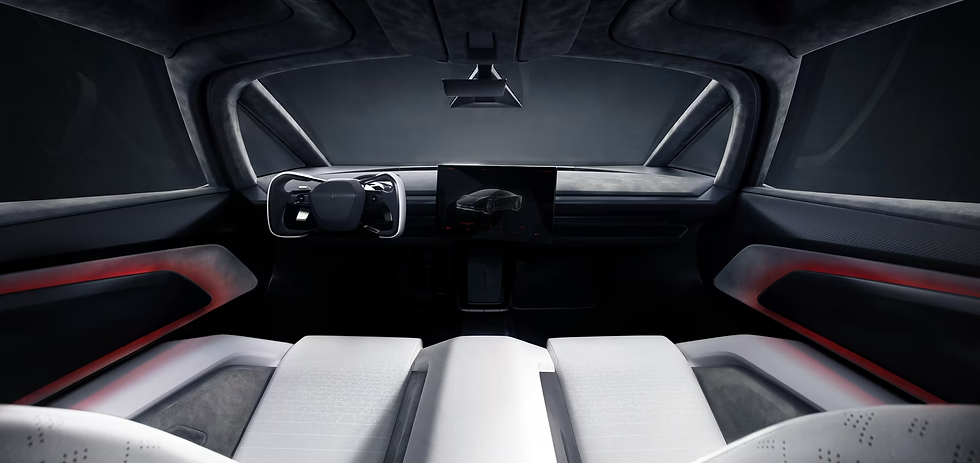
Tesla has listed three broad versions. The Performance model includes the fan-based downforce system. The Thrust model adds the compressed-air acceleration thrusters. The invitation-only Rocket model is the most extreme configuration and is described by Tesla as having a full flight system; Reuters reported that this version is single-seat, unlike the road-ready two-seat configuration. Tesla’s current website also warns that the Rocket trim and thrust-related features may not be available in every region.

Pricing has not been finalized. Tesla originally announced a $200,000 starting price for the Roadster in 2017, with a $250,000 Founders Series, but Reuters reported that the company did not give a new target price at the 2026 reveal. Current reservation payments are reported at $50,000 for Performance and $250,000 for Thrust, with the payment structure described as a $5,000 initial deposit followed by the balance within ten days. The car is also listed as left-hand-drive only in some markets, and questions remain about how features such as flight demonstrations and extreme thrust could comply with public-road regulations.
The new Roadster therefore serves two purposes. It is a halo car intended to display Tesla’s most advanced performance technology, and it is a bold statement about how far an electric vehicle can go beyond conventional sports-car design. If Tesla can turn these promises into a reliable, road-legal production car by 2028, the Roadster could become one of the most unusual performance EVs ever built. For now, its record-breaking numbers and flying capability remain impressive, but still await production reality and independent verification.


